top of page
Co-Curing vs. Co-Bonding of CFRP–Nomex Sandwich Structures
This project focuses on the experimental characterization and optimization of CFRP–Nomex sandwich structures by investigating how their design and manufacturing parameters influence mechanical performance, defect formation, and failure mechanisms. The study evaluates key variables including core thickness, honeycomb cell geometry and size, core configuration, and CFRP skin thickness.
Mechanical testing and failure analysis are used to establish relationships between sandwich architecture, structural response, and dominant damage mechanisms, providing design criteria for lightweight structures with improved mechanical efficiency and reliability.
Location
Institute of Applied Research for the Aeronautical Industry (INAIA), Industrial and Aerospace Engineering School of Toledo (EIIA), University of Castilla-La Mancha (UCLM)
Date
2023
Project type
Undergraduate bachelor thesis

01
Co-Curing vs. Co-Bonding of CFRP–Nomex Sandwich Structures
01
CFRP–Nomex Sandwich Panel Manufacturing
Complete manufacturing process of CFRP–Nomex honeycomb sandwich panels, from carbon-fiber skin lay-up to vacuum bagging and curing. This lightweight configuration combines thin CFRP skins with a Nomex honeycomb core to achieve high stiffness and strength, particularly under out-of-plane loading, while significantly reducing structural weight compared with monolithic configurations.

02
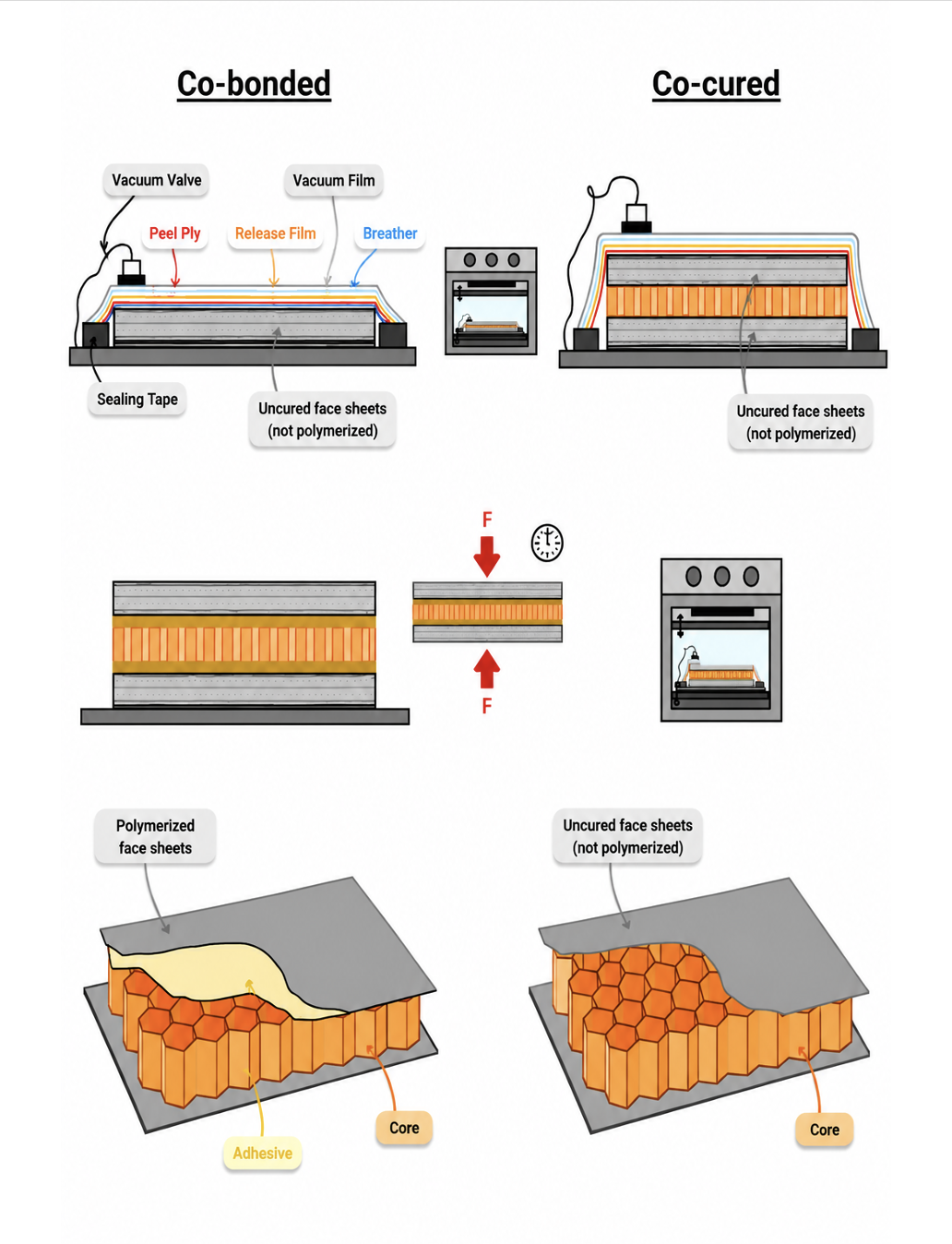
Co-Curing vs Co-Bonding Manufacturing Routes
Schematic comparison of the complete manufacturing routes for CFRP–Nomex sandwich panels. Co-curing integrates skin curing and sandwich consolidation into a single stage, reducing processing time, adhesive use, and resource consumption, but involves a more complex curing process. Co-bonding uses pre-cured skins subsequently bonded to the Nomex core, requiring additional processing stages and structural adhesive.

03
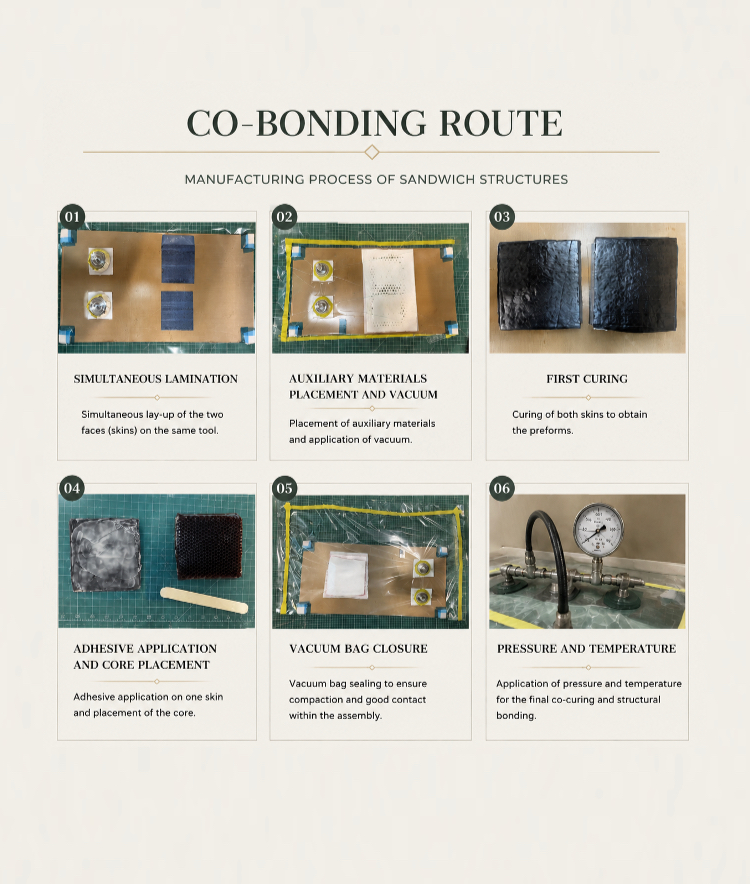
Co-Bonding Manufacturing Process
Image sequence showing the complete co-bonding manufacturing route for CFRP–Nomex honeycomb sandwich panels. The process includes simultaneous lay-up and curing of the carbon-fiber skins, adhesive application, Nomex honeycomb core placement, vacuum bagging, and a second curing stage under controlled pressure and temperature to achieve the final structural bond.

04
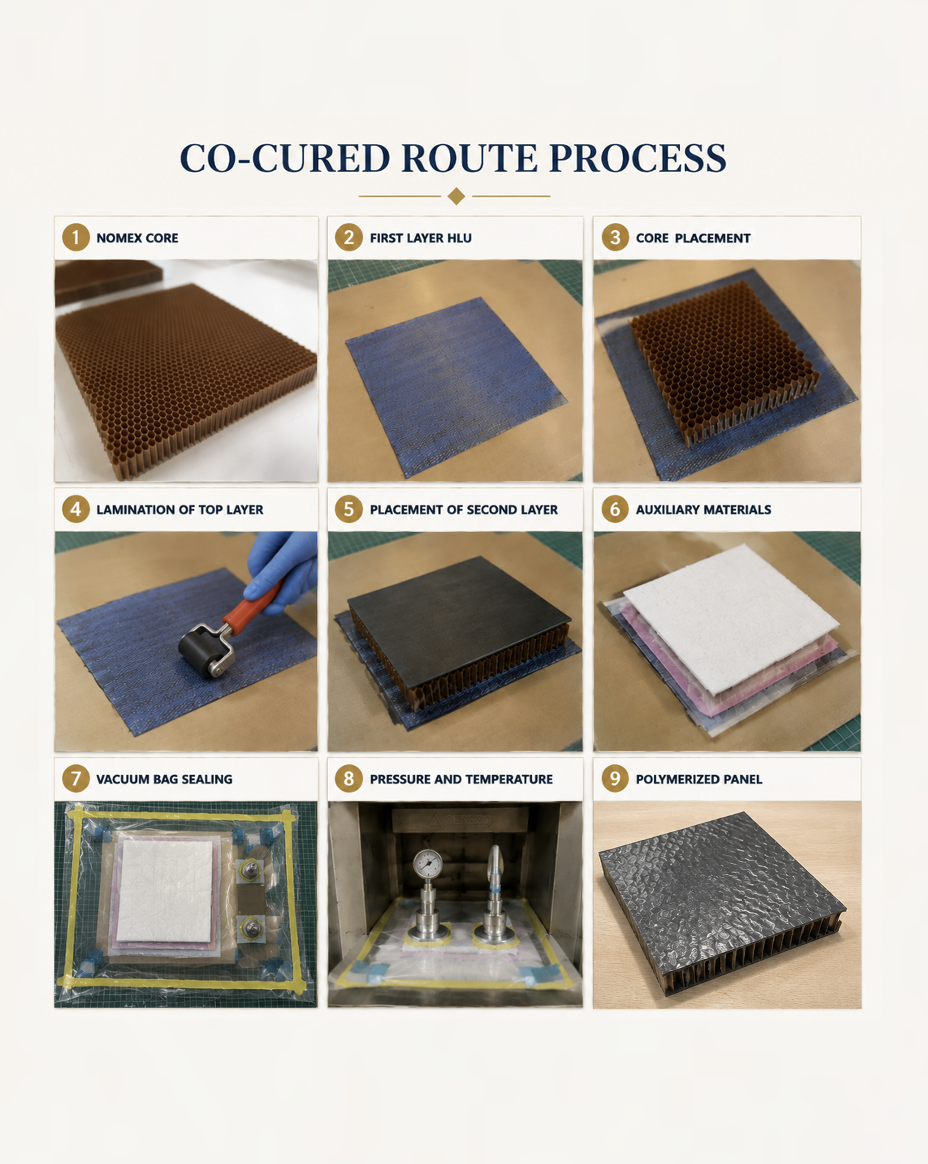
Co-Curing Manufacturing Process
Image sequence showing the complete co-curing manufacturing route for CFRP–Nomex honeycomb sandwich panels. The process integrates carbon-fiber skin lay-up, Nomex honeycomb core assembly, auxiliary materials and vacuum bagging, followed by a single curing stage under controlled pressure and temperature.

05
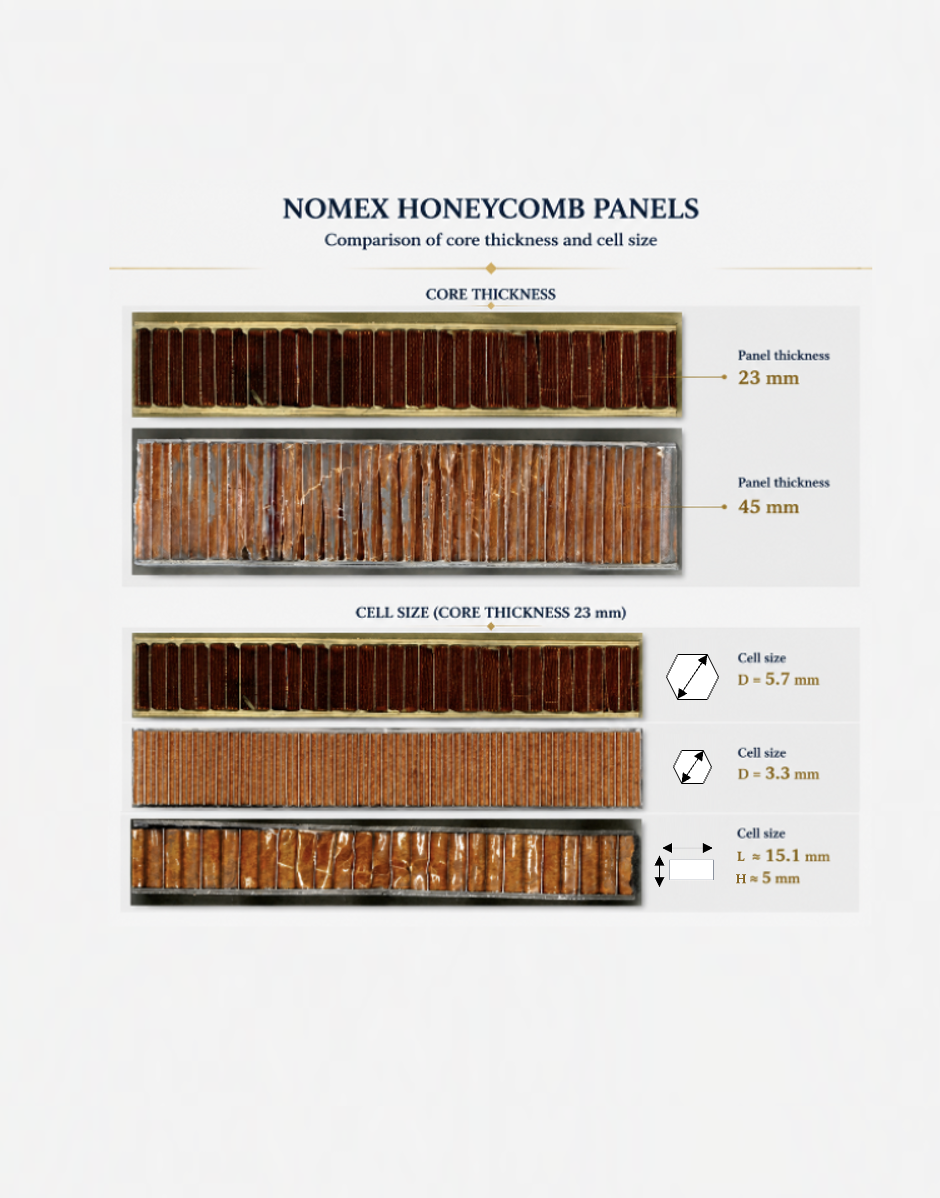
Influence of Honeycomb Core Parameters
Comparison of CFRP–Nomex sandwich panels manufactured with different honeycomb core configurations. Core thickness, cell geometry, and cell size are varied to investigate their influence on the structural response and identify configurations that provide an optimal balance between mechanical performance and weight.

06
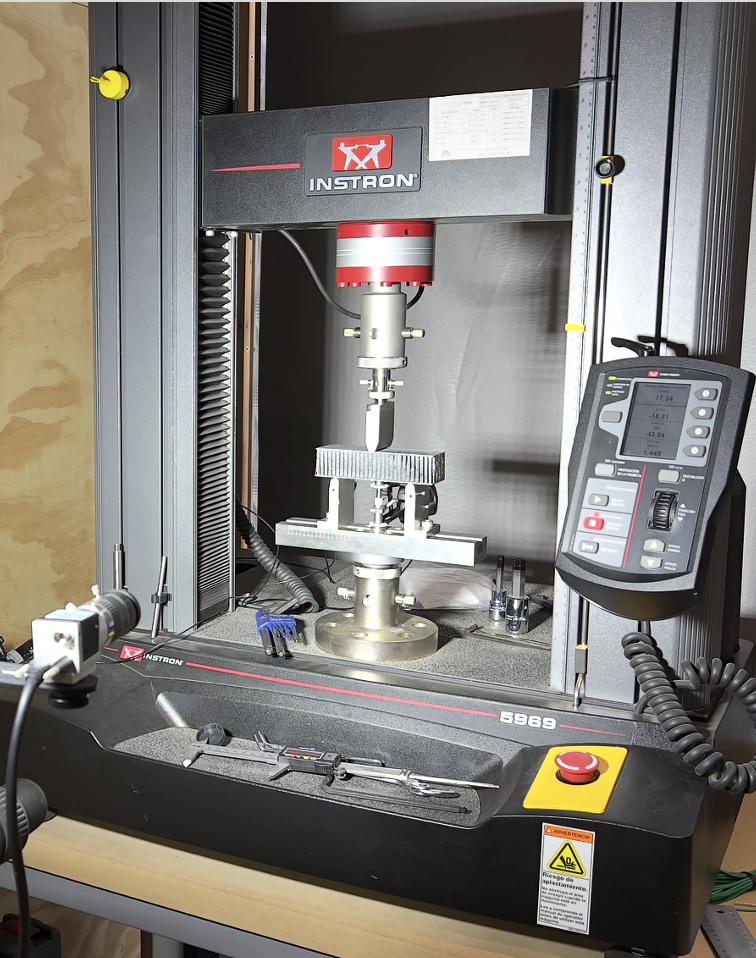
Mechanical Testing of CFRP–Nomex Sandwich Panels
CFRP–Nomex sandwich panel mounted on a universal testing machine for mechanical characterization. The experimental setup enables controlled loading to evaluate the structural response, stiffness, strength, and failure behavior of the sandwich configuration, where the Nomex honeycomb core primarily provides out-of-plane resistance, while the CFRP skins carry the in-plane loads.
07
Shear Testing of a Co-Bonded CFRP–Nomex Sandwich Panel
Mechanical shear test of a co-bonded CFRP–Nomex sandwich panel, showing the progressive structural response under loading and the resulting delamination failure mode. The test enables evaluation of interfacial integrity and provides insight into how damage develops and propagates within the sandwich structure.
08
Shear Testing of a Co-Cured CFRP–Nomex Sandwich Panel
Mechanical shear test of a co-cured CFRP–Nomex sandwich panel, showing the progressive development of core instability followed by skin failure. This failure sequence highlights the influence of the integrated co-curing route on load transfer and the mechanical response of the sandwich structure.
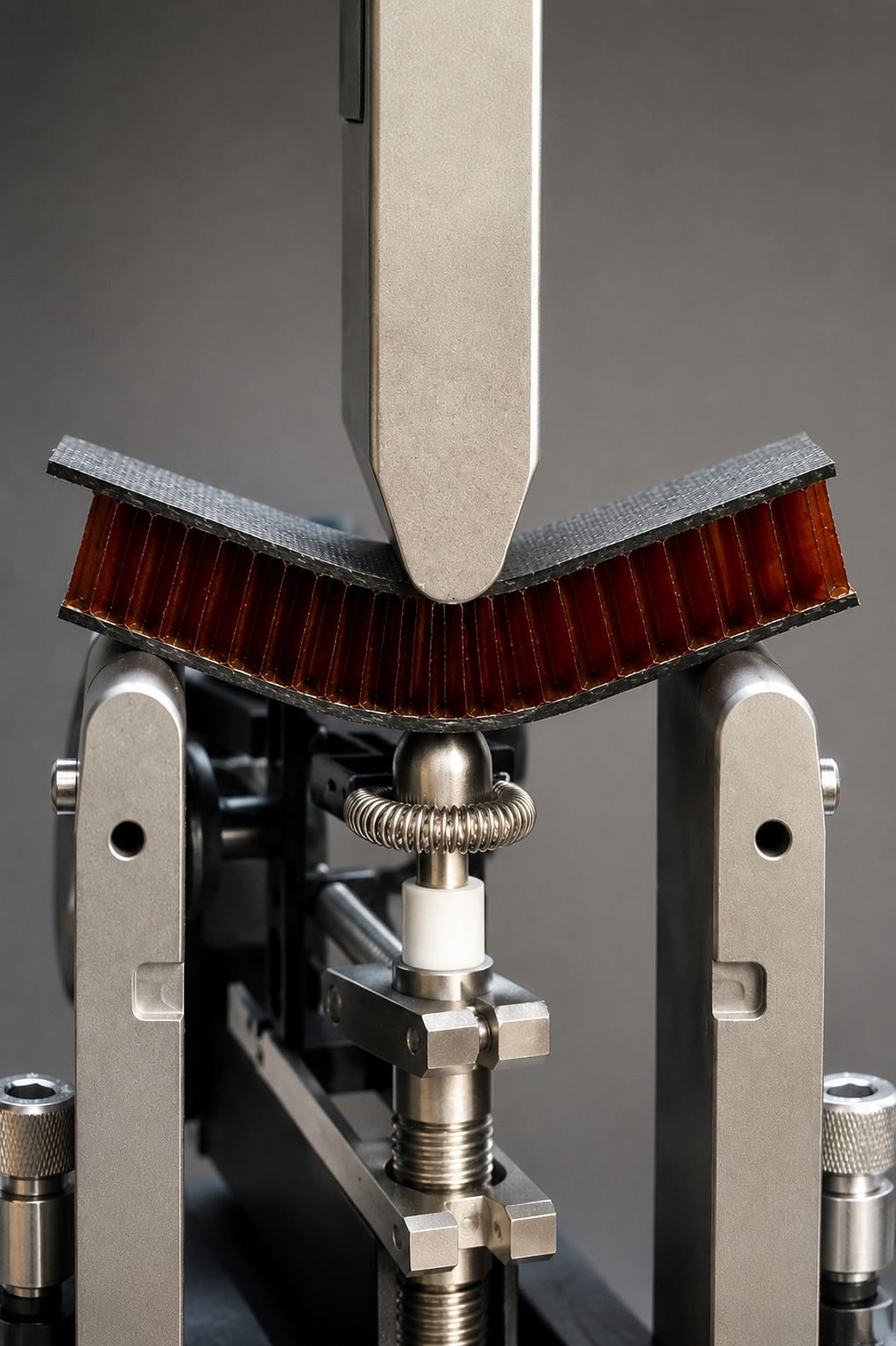
09
Flexural Testing of a Co-Bonded CFRP–Nomex Sandwich Panel
Flexural test of a co-bonded CFRP–Nomex sandwich panel, showing delamination at the skin–core interface as the dominant failure mode. The test highlights the critical role of interfacial bonding in load transfer and the flexural performance of the sandwich structure.
10
Flexural test of a co-cured CFRP–Nomex sandwich Panel.
Flexural test of a co-cured CFRP–Nomex sandwich panel, showing core instability as the dominant failure mechanism under bending. The test highlights the role of the honeycomb core in maintaining structural stability and transferring loads between the CFRP skins.
11
Flexural Shear Failure of a Co-Cured CFRP–Nomex
Flexural test of a co-cured CFRP–Nomex sandwich panel showing shear failure of the honeycomb core, characterized by the development of an approximately 45° diagonal crack. This failure mode illustrates the shear-dominated response of the core under bending loads.

12
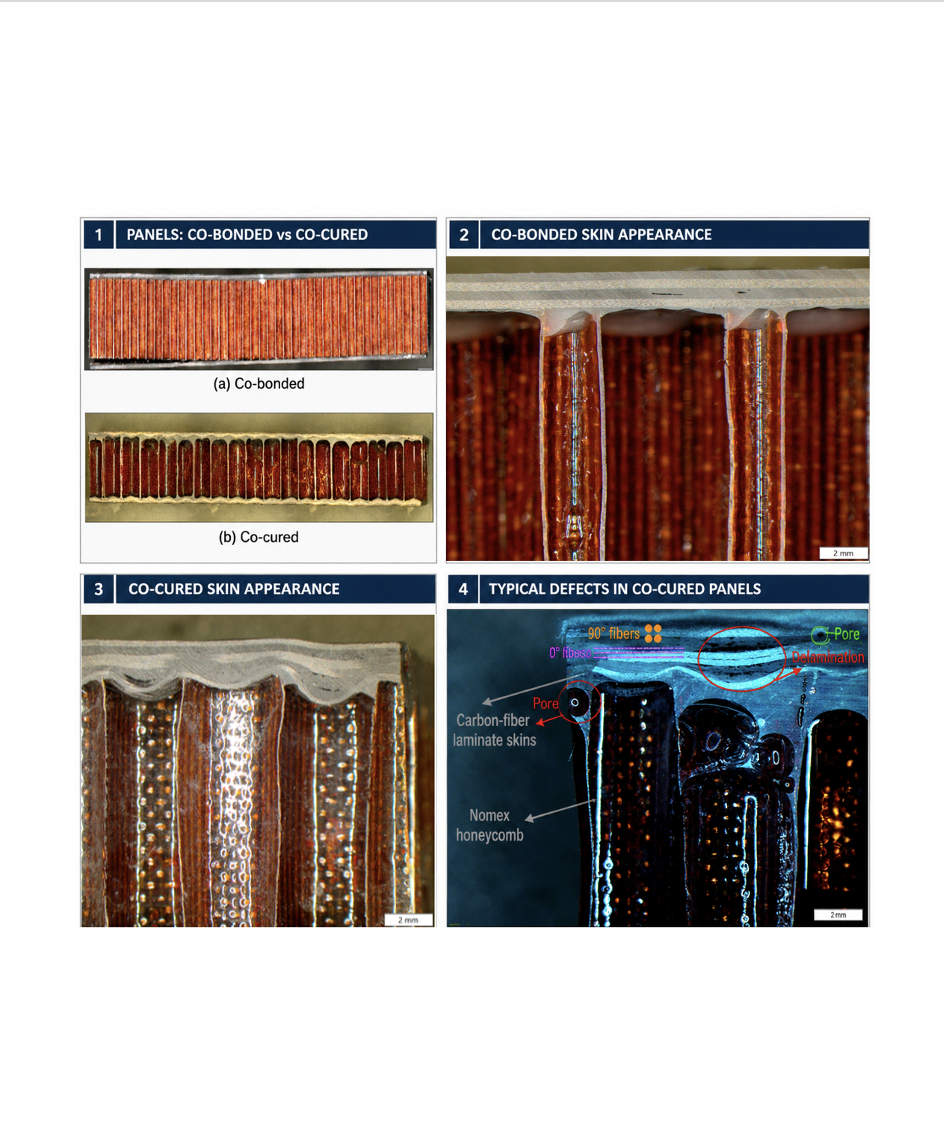
Manufacturing Defects in Co-Bonded and Co-Cured CFRP–Nomex Panels
Comparison of characteristic defects associated with co-bonding and co-curing routes in CFRP–Nomex sandwich panels. Co-bonded panels can exhibit excess adhesive accumulation within the honeycomb cells, while co-cured panels may develop skin waviness due to the stiffness mismatch between the Nomex core and the uncured CFRP skins during vacuum and pressure application, causing local skin indentation between the core support regions.

13
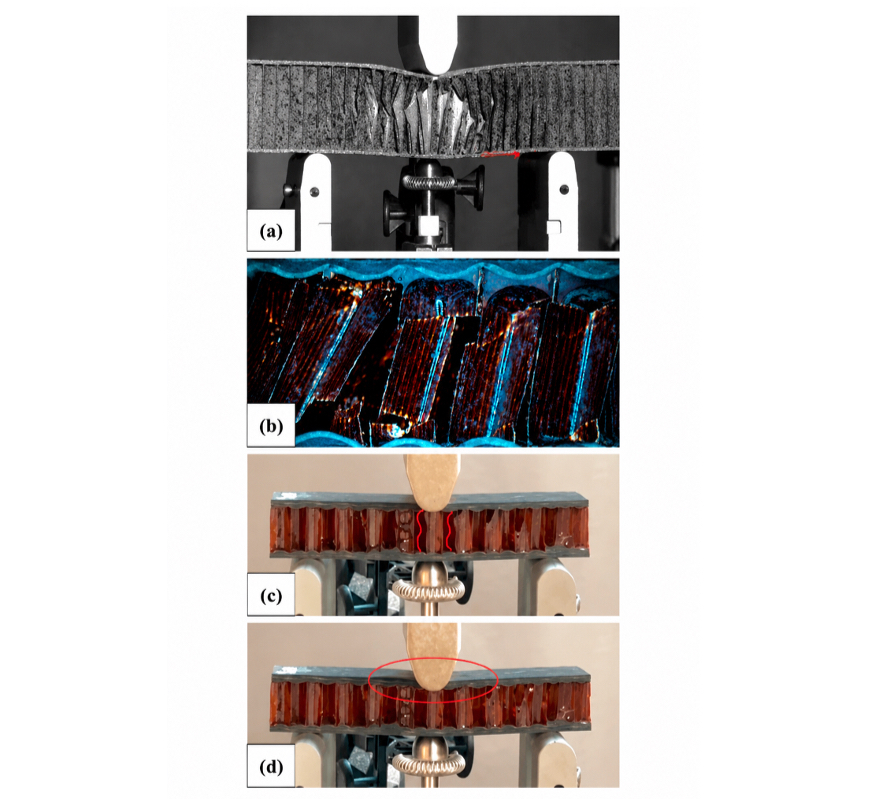
Failure Modes in Co-Cured CFRP–Nomex Sandwich Panels
Comparison of different failure stages observed during mechanical testing of Co-Cured CFRP–Nomex sandwich panels, highlighting characteristic mechanisms including honeycomb core buckling, core shear failure, and CFRP skin buckling. The sequence illustrates how different structural instabilities develop and govern the final failure of the sandwich configuration.

14
Delamination Failure in a Co-Bonded CFRP–Nomex Sandwich Panel
Delamination observed during mechanical testing of a co-bonded CFRP–Nomex sandwich panel, showing progressive separation at the skin–core interface under loading. This failure mechanism highlights the critical role of adhesive bonding and interfacial integrity in the mechanical performance of co-bonded sandwich structures.
- Schematic comparison of co-curing and co-bonding routes for CFRP–Nomex sandwich panels, showing the main manufacturing stages from skin lay-up to final consolidation.
- Image sequence showing the complete co-bonding process of a CFRP–Nomex honeycomb sandwich panel, from carbon-fiber skin lay-up and pre-curing to adhesive application, core assembly, vacuum bagging, and final curing under pressure and temperature.
- Image sequence showing the complete co-curing process of a CFRP–Nomex honeycomb sandwich panel, from carbon-fiber skin lay-up and core assembly to vacuum bagging and final curing under controlled pressure and temperature.
- Comparison of CFRP–Nomex sandwich panels with different Nomex honeycomb core thicknesses, cell geometries, and cell sizes.
- CFRP–Nomex honeycomb sandwich panel mounted on a universal testing machine for mechanical testing and structural characterization.
- Comparison of co-bonded and co-cured CFRP–Nomex sandwich panels showing excess adhesive accumulation in honeycomb cells and skin waviness caused by local indentation during co-curing.
- Comparison of failure modes in Co-Cured CFRP–Nomex sandwich panels showing honeycomb core buckling, core shear failure, and CFRP skin buckling during mechanical testing.
- Co-bonded CFRP–Nomex sandwich panel showing progressive delamination between the CFRP skin and Nomex honeycomb core during mechanical testing.
bottom of page