top of page
Solar Debinding & Sintering of MEX Components
Metal additive manufacturing is often associated with high equipment and energy costs. This project combines Material Extrusion (MEX) with Concentrated Solar Energy (CSE) as a more accessible and sustainable route for metallic component production. Solar energy is used for both debinding and sintering, reducing conventional energy requirements while MEX enables low-cost manufacturing. The approach is being explored for Inconel 718, Ti-6Al-4V, and Al 6061, targeting aerospace, turbine, and lightweight structural applications.
Project type
JCCM Scientific Research & Technology Transfer Project
Location
Institute of Applied Research for the Aeronautical Industry (INAIA), University of Castilla-La Mancha (UCLM)
Date
2024-2027

01
Solar Debinding & Sintering of MEX Components

01
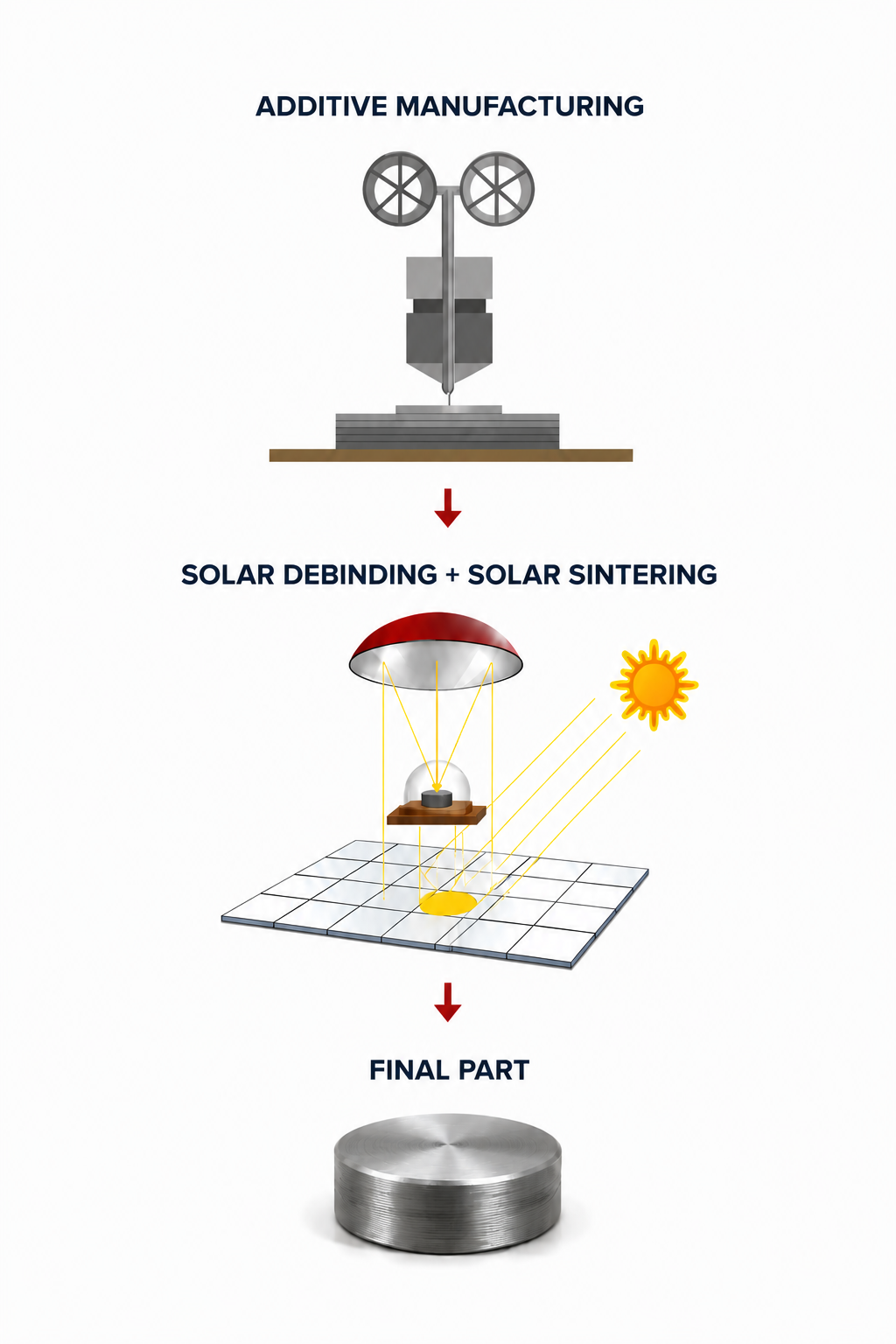
Solar Processing of MEX 3D-Printed Metal Components
Stages of metal component processing using Concentrated Solar Energy (CSE). Material Extrusion (MEX) enables metallic components to be consolidated by sintering below the melting temperature, reducing the energy required for processing. After 3D printing, concentrated solar radiation provides the thermal energy required for debinding and subsequent sintering. Solar radiation is focused by a solar concentrator and directed toward the material, enabling localized high-temperature processing using sunlight as the primary thermal energy source.
02
Low-Cost MEX 3D Printing of Metal Components
Printing of Ti-6Al-4V components using low-cost Material Extrusion (MEX) 3D printing. The filament consists of metallic powder combined with a polymeric binder, allowing the material to be extruded by melting only the polymeric phase while the metallic particles remain solid. The printed components are subsequently subjected to solar debinding and solar sintering using Concentrated Solar Energy (CSE), followed by materials characterization to evaluate densification, microstructure, and final properties after solar processing.

03
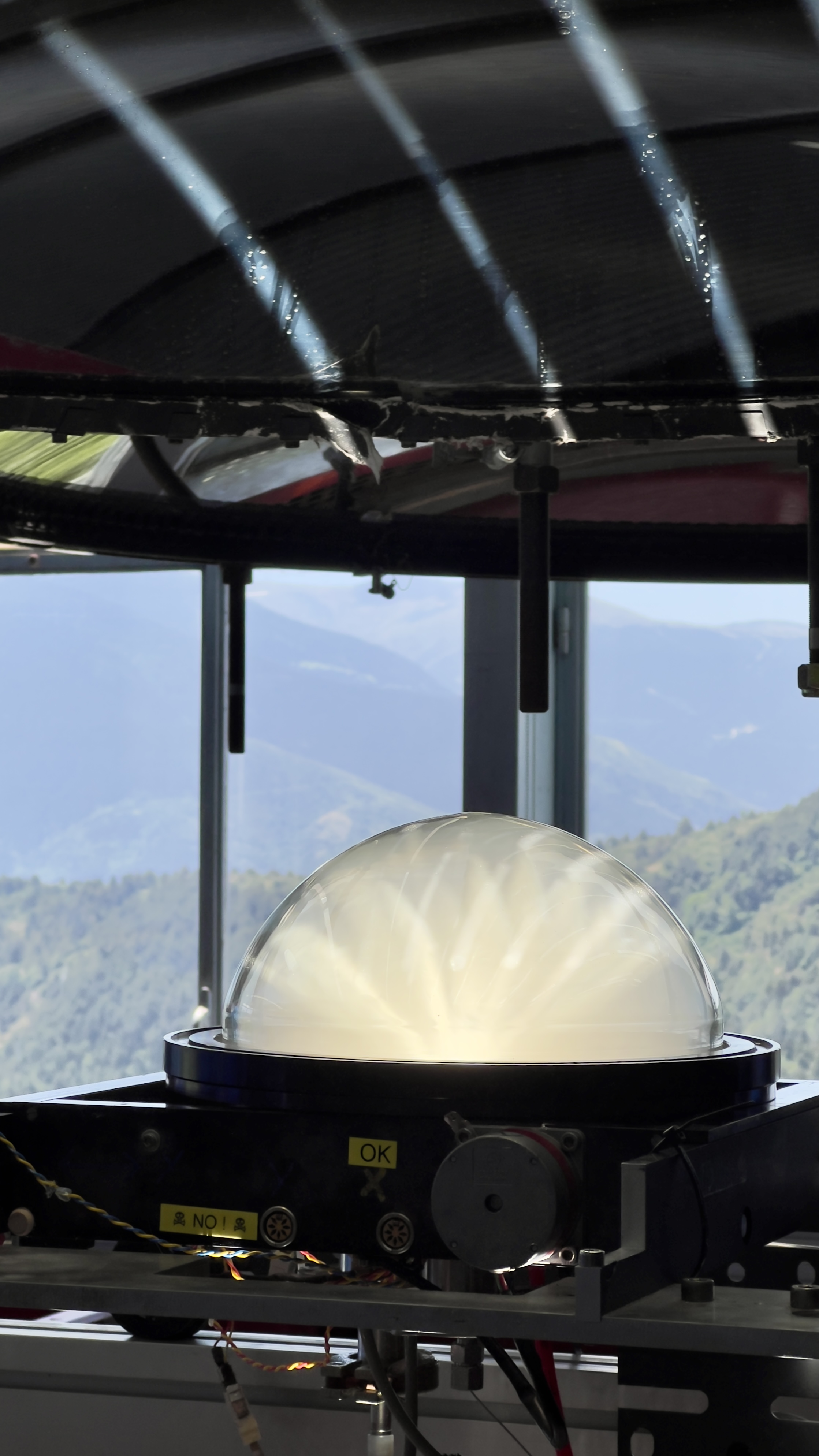
Solar Thermal Debinding at the Odeillo Solar Furnace
Solar thermal debinding of metal components at the Odeillo Solar Furnace. The image captures the process in operation, showing concentrated solar radiation entering the reaction chamber while gases released by the thermal decomposition of the polymeric binder fill the chamber. Concentrated Solar Energy (CSE) provides the thermal input required for binder removal prior to the subsequent solar sintering stage.
04
Solar Thermal Debinding of Ti-6Al-4V MEX Components
Solar thermal debinding of cylindrical Ti-6Al-4V components manufactured by low-cost Material Extrusion (MEX), performed at the Odeillo Solar Furnace. Concentrated Solar Energy (CSE) is used as the thermal source to remove the polymeric binder prior to solar sintering, replacing conventional furnace heating with a high-flux renewable energy source.

05
Solar Sintering of a Complex Ti-6Al-4V Technological Demonstrator
Complex Ti-6Al-4V ring used as a technological demonstrator during solar sintering at the Odeillo Solar Furnace (PROMES-CNRS). Concentrated solar radiation is directly focused onto the component inside the reaction chamber, providing the high thermal power required for sintering and densification. The ring demonstrates the feasibility of applying Concentrated Solar Energy (CSE) to the thermal processing of MEX 3D-printed metallic components with complex geometries.

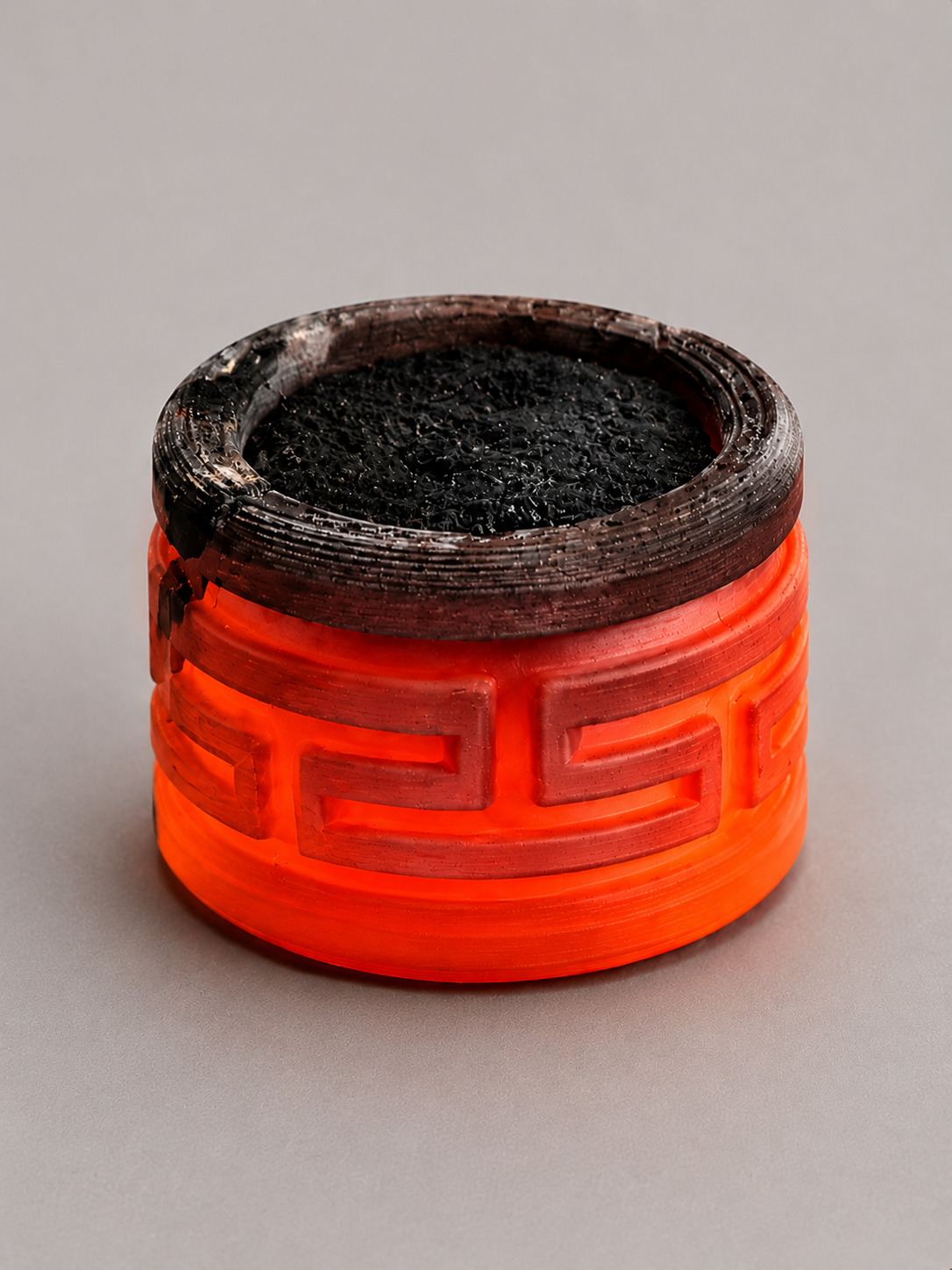
06
Cooling of a Complex Ti-6Al-4V Technological Demonstrator After Solar Sintering
Ti-6Al-4V ring used as a technological demonstrator of a complex geometry during the cooling stage after solar sintering using Concentrated Solar Energy (CSE) at the Odeillo Solar Furnace (PROMES-CNRS). The component demonstrates the applicability of the process to MEX 3D-printed parts with complex geometries. The visible red glow reflects the high temperatures reached during solar processing.

07
Cooling of a Ti-6Al-4V Sample After Solar Sintering
Ti-6Al-4V sample during the cooling stage after sintering with Concentrated Solar Energy (CSE) at the Odeillo Solar Furnace (PROMES-CNRS). The red-hot appearance of the sample reflects the high temperatures reached during processing, exceeding 1200 °C, while its compact morphology indicates the high degree of densification achieved through solar sintering. The high solar flux delivered directly to the sample enables rapid heating and promotes densification within short processing times.

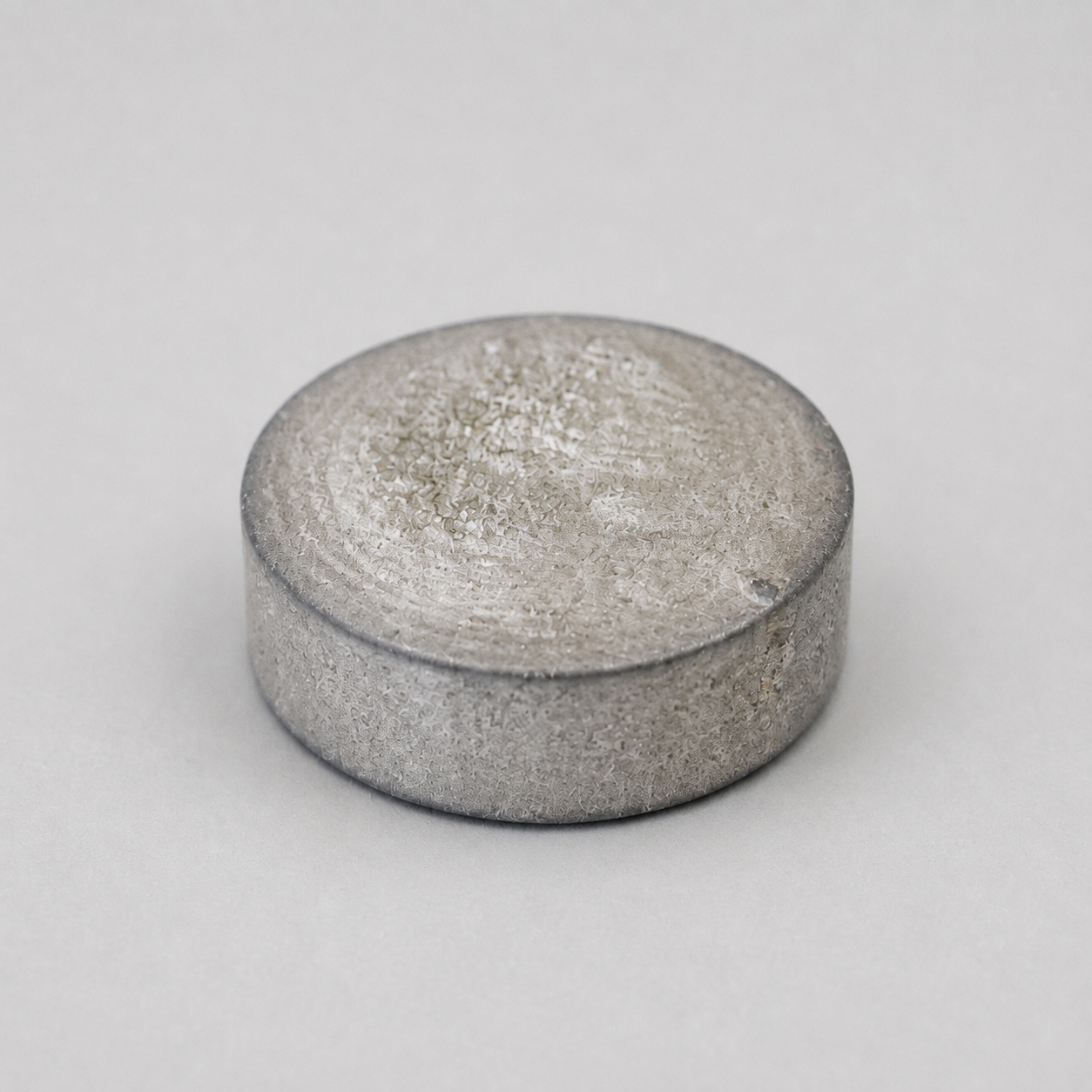
08
Solar-Processed Ti-6Al-4V MEX Component
Cylindrical Ti-6Al-4V specimen manufactured using low-cost Material Extrusion (MEX) 3D printing and subsequently processed through solar debinding and solar sintering using Concentrated Solar Energy (CSE). The metallic surface finish and high degree of densification achieved in the final component demonstrate the potential of solar thermal processing to produce dense, high-performance metallic parts from MEX-printed components.
- MEX 3D-printed metal component processing using Concentrated Solar Energy (CSE), showing the main stages from printing to solar debinding and sintering to obtain the final consolidated metallic component.
- Ti-6Al-4V MEX components undergoing solar thermal debinding at the Odeillo Solar Furnace, with concentrated solar radiation entering the reaction chamber and binder decomposition gases visible during processing.
- Complex Ti-6Al-4V ring used as a technological demonstrator during solar sintering at the Odeillo Solar Furnace, with concentrated solar radiation directly focused onto its surface inside the reaction chamber.
- Cooling of a Complex Ti-6Al-4V Technological Demonstrator After Solar Sintering
- Red-hot cylindrical Ti6Al4V sample during sintering with concentrated solar energy at the Odeillo Solar Furnace, showing a high degree of densification.
- Highly densified cylindrical Ti-6Al-4V MEX specimen after solar debinding and sintering using Concentrated Solar Energy, showing its characteristic metallic surface finish.


bottom of page